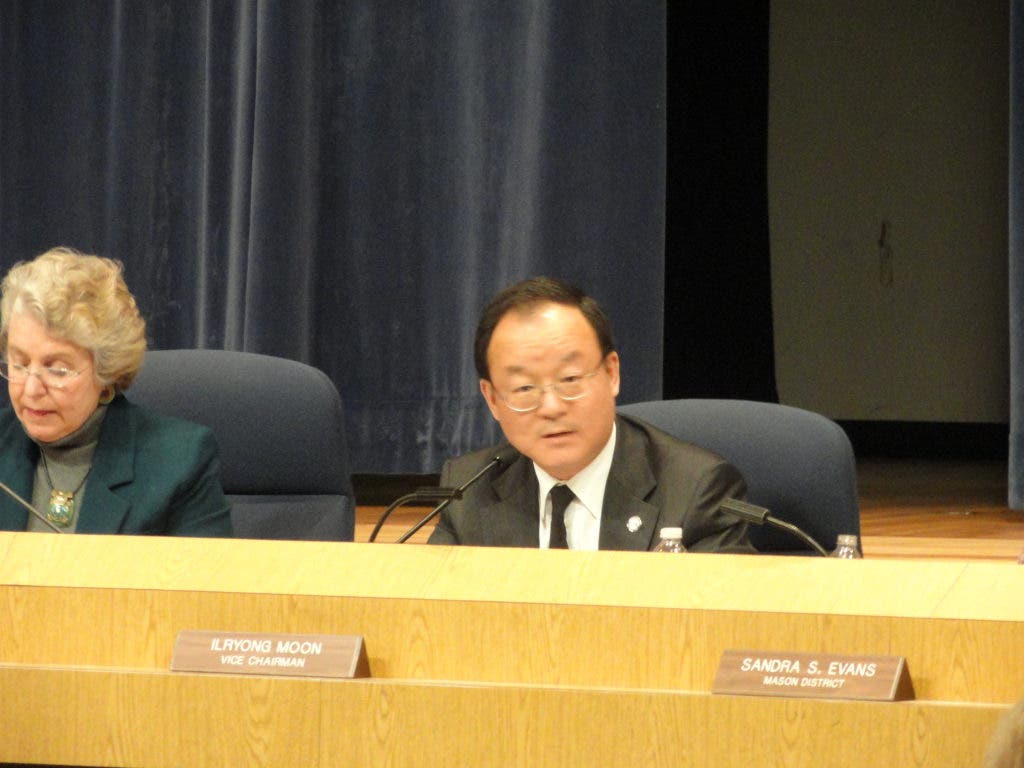
A week before the Fairfax County School Board is scheduled to approve a fiscal year 2013 budget, community members advocated Tuesday for closing achievement gaps, increasing funding for employee compensation and providing benefits to parent liaisons at a public hearing for next year's spending plan.
during a markup session Monday, which removes step increases for eligible employees and calls for a 2 percent compensation market rate adjustment (MRA).
The payment changes come in light of this year's General Assembly legislation requiring public school employees who participate in the Virginia Retirement System (VRS) to pay a 5 percent employee contribution, which school systems currently pay. To offset the increased contribution, the legislation also requires school systems to pay a 5 percent salary increase to employees.
Dale has proposed to implement a full shift to 5 percent in 2013 rather than incrementally over the next five years. Additionally, he proposed FCPS take on 2 percent of teachers’ contributions to the Educational Employees’ Supplementary Retirement System of Fairfax County (ERFC). Employees currently pay 4 percent to the fund.
Fairfax County Patch sites are Facebook! Become a fan at www.facebook.com/fairfaxcopatch.Emotional Testimonies
About 50 speakers testified before the school board during the 2.5-hour hearing. At Monday's work session, board members emphasized the public hearing would hold significant weight in how it proceeds with the budget plan.
"We are feeling betrayed," said Kimberly Adams, representing the Fairfax Education Association. "The school board can and must make its employees a priority. The 4 percent MRA we are calling for offsets the losses from VRS changes and provides for a decent [rate] similar to that of county employees."
Fairfax County teachers are, on average, paid the third-most in the state, according to Virginia Department of Education data, behind Arlington County and Alexandria City public school systems. Arlington and Alexandria have average teacher salaries of roughly $70,000. Fairfax County has an average teacher salary of about $64,000.
Lauren Villa, a history teacher at South Lakes High School, drew rousing applause from fellow educators during her emotional testimony.
"In his 2008 State of the Union address, President Obama called [teachers] nation builders. Do you believe that?" she asked the board, holding back tears.
Steven Greenburg, president of the Fairfax County Federation of Teachers, advocated for both teacher pay and an independent school board staff.
"You need staff of your own to better respond to your constituencies," he said. "The FCPS budget is over $2 billion a year and you need to properly focus … so we can cut the waste and get the money to the classroom for the kids and the teachers.
"We understand what it means to be overworked. Enough is enough."
Parent Liaisons
Other citizens testified in support of parent liaison benefits, which the school board will vote on before the budget is adopted.
Julie Bell, a Bucknell Elementary parent and PTA representative, said she considered parent liaisons as school staff.
"There’s an incredible workload for these individuals, and the value of their service to our schools and community is priceless," Bell said. "They conduct classes to teach English and Spanish. They teach computer courses to those parents who are novices to technology.… They are integral in providing services to those in need and making a better tomorrow."
Parent liaison Marcia St. John-Cunning spoke on behalf of herself and her 127 colleagues in the FCPS system.
"Most of us carry a full-time workload and manage to accomplish it on a part time schedule," she said, adding that the relationships she has made with parents are invaluable. "Parents have confided in me about domestic violence, unscrupulous slumlords, employers that are exploiting them … gang activity, teen pregnancy, homelessness and hunger."
Parent liaisons help resolve these issues by being proactive, said St. John-Cunning, who has been in the program for 12 years.
"We need and deserve health and retirement benefits," she said.
Achievement Gaps
Sheree Brown-Kaplan, who recently ran for a position on the school board, testified on behalf of the Coalition of the Silence, an organization founded by former at-large school board member Tina Hone that advocates for youths underserved by the school system.
She and the Coalition also supported parent liaison benefits, but called for the school board to look more closely at funding for programs that would help close the reading achievement gaps among students.
Brown-Kaplan said reading proficiency by the end of third grade had to be made a student achievement goal for which the school board could be held accountable.
The Coalition applauded the adjusted package’s inclusion of funding for extended learning time.
"Let’s focus on closing the achievement gap," said Hone, who also spoke to the board at Tuesday's hearing. "Using an outcome-oriented approach, you would need a smaller class size in needier schools, more time in school for at-risk kids … [a] laser focus on third grade reading.
"We consider this budget a good start," she said. "Next year we want a better start."
The school board will further discuss the budget at a work session 7 p.m. Thursday at Luther Jackson Middle School. A vote on the budget will be taken May 24.
I agree that the home environment is critical to developing pre-literacy skills. Quality preschool services are an important component of preparing very young children for reading instruction. However, I don't believe it's appropriate to blame the achievement gap on poor, struggling families. Children in poverty can achieve at just a high level as their wealthier peers. Having taught years ago, you may be unfamiliar with "response to intervention" (RtI) which was mandated by IDEA 2004. The premise of RtI is that many children identified with a learning disability have been the product of inappropriate instruction. RtI aims to "weed out" those children through a process of documented interventions; if a child fails to respond to those standard services, there's a high likelihood of the presence of a learning disability for which the child should be evaluated. The point is that we don't have to guess which of our youngest students are at-risk of reading failure; we have the tools to reliably identify and serve them. Yet, to be successful, reading intervention services have to be implemented early. The "wait to fail" model used in FCPS is harmful to students because past 3rd grade academic problems are difficult to remediate even with the most intensive efforts. Many students placed in special education after the first 3 years of elementary school show minimal improvements and few will ever exit the expensive services they require.
The evidence you cite is correct, but limited. The lack of reading proficiency is the cause of the broader achievement gap - but that lack of proficiency itself is caused by other factors. The biggest factors behind low reading proficiency include teacher skill and curriculum delivery - but they also include oral-language environment at home, and the relative size of students' vocabulary on entering kindergarten. By the age of four, children with 'professional' parents have over TWICE the vocabulary of children whose parents did not complete high school, and they have heard several MILLION more words spoken cumulatively within their home. This is a gap that can be overcome with dedicated, focused, and supported teaching staff - but it is still a gap, and one you cannot lay entirely at the feet of the school system.
The 3rd grade Reading SOL failure rates for these subgroups are listed on page 9 -- https://p1pe.doe.virginia.gov/reportcard/report.do?division=29&schoolName=All.
You make an excellent point and demonstrate why it's so important to have a home-school partnership with the vision of supporting the whole child. The size of a child's vocabulary, as you point out, is one of those important markers for reading success. The most important thing a parent can do for a child's education is read to him or her. In my own family, we started reading every night to our children as babies which, in part, helped them become the accomplished readers they are today. Not all children start school so well prepared as mine but, even with the varied levels of development among kindergarteners, most who lack a high exposure to vocabulary will catch up with their peers. It's the children who show signs of atypical reading development that need the explicit, supportive and intensive interventions that research has proven effective and schools can provide. However, those services need to be implemented early to be successful. Schools cannot chose which children come to them, but they can choose which services to offer and when to provide them.
I'm not sure we really disagree--I think we may be talking on different levels. I agree that we absolutely cannot wait until third grade to identify these children. As a first grade teacher, I remember being very frustrated when I had a student that I knew had a learning disability, but did not yet fit what they then called the "federal formula"--they weren't yet far enough behind. I believe that we are talking about two different things. Language delay due to a disability and language delay due to environment may overlap, but sometimes they do not. I agree that early identification is key. I taught for four years in a high poverty school and then for eight years in low-middle to middle income schools. The kids in the high poverty school were capable, but many just did not have the language skills to succeed in reading by third grade. (This was years ago and most had not even been to Kindergarten.) Reading does no good if you do not have language comprehension to go with it. We do need early intervention with these kids, but the parents must be aware of the opportunities. In this day of cable television and video games, poor children are not necessarily even watching children's shows on tv--much less being read to. I personally think that we need a huge advertising campaign on the importance of reading and TALKING to your children from a very early age. I am concerned that even the more educated parents are ignoring their children for the cell phone.
I would LOVE to see FCPS invest in an advertising campaign on the importance of reading and TALKING to your children from a very early age. Rather than spend millions of dollars on self-promotion, FCPS should plaster the back of every bus with a poster about reading instruction being JOB #1 for schools and parents. That which gets our attention gets our time and effort.
The more serious issue with non-English speaking kids is communication and support with parents who do not speak English and with non-English speaking kids starting school at a later age. Some have never been in school at all. You will be amazed at how quickly the younger children will learn to speak English.
There used to be a federal program with TV advertising (days of Barbara Bush, maybe??). on the importance of reading. I really think the coalition should investigate this as a possibility. How to educate parents BEFORE the kids come to school. One thing I firmly believe is that all parents love their kids and want what is best for them--but some just don't know how important literacy and language are--any language. I don't know how to reach them, but I suspect that most food banks and social service organizations would be happy to give away books if someone provided them. Perhaps clinics would also be a source. A quick reminder from anyone that it is important to TALK and develop language skills. Even if the parents are not literate, they can look at pictures with their children and talk about them. We assume that this is a natural instinct with parents--but it is not. Even waiting for a bus is an opportunity to talke about colors and cars, etc. The coalition really should push for this with FCPS and other organizations. Also, older children could have an impact. Teachers should be encouraged to tell the kids to help their preschool and baby siblings learn language, etc.
I understand your concern and I agree it is not an ideal situation. However, I have seen some non-English speaking kids pass their English speaking peers very quickly-even by December. I feel pretty confident that FCPS will provide additional help for the non-English speaking kids and that your son will have every opportunity to succeed. There is always a discrepancy in level in any class. Even in GT classes and "tracked" classes, some students will be way above and some below the average. Think about it. In the "olden" days there were one room schoolhouses--and it worked. Just be sure that you continue to support your child at home and encourage him to read and he will do fine.
English speaking classmates at the expense of the native English speakers.
As far as your reading recommendation, I have already read it. Another thing that many people don't realize - teachers are actually very well informed. Much of what I read for pleasure is related to educating young people...and what I don't choose to read on my own, is assigned reading for professional development. :) I do not mean in any way to be sarcastic - please don't misread my tone. I am just saying that you are preaching to the choir. :)
Reading on grade level by the end 3rd grade is absolutely critical to student success because that's when children go from learning to read to reading to learn. Kids will be left behind if they can't read well; they have an equal opportunity to succeed if they can read well. In fact, reading proficiency by the end of 3rd grade has been proven to close the achievement gap. A 2010 study demonstrate that if White, Black and Hispanic students are equally proficient in reading, they basically have the same high rate of graduation — above 90%. If minority students did not reach reading proficiency, large gaps in achievement emerged.
http://www.americanthinker.com/2012/05/racism_and_the_pc_inquisition.html
"The Washington Post reports that honors classes are being abolished from the curriculum in Fairfax, VA, and in many other schools around the country. Schools generally have three tracks of courses: basic, honors, and advanced placement (AP). Honors classes are being eliminated because "traditionally underrepresented minorities" are not taking enough AP courses. The fact that many non-minority students benefited from and enjoyed the honors courses is beside the point in a PC regime." http://www.americanthinker.com/2012/05/racism_and_the_pc_inquisition.html
http://www.nuffieldfoundation.org/sites/default/files/files/ceedp137.pdf The percentage of primary school children in England who do not speak English as their first language has risen by a third to 12% over the past 10 years. This has led to concern from some that it could be having a negative impact on native English speakers' achievement because teachers' time would be taken up helping students whose second language is English. However, according to a study from the Centre for the Economics of Education, this concern is unwarranted. The research used data from the National Pupil Database to explore the correlation between the proportion of non-native English speakers in a grade level and educational achievement of native English speakers at the end of primary school. A second approach looked specifically at evidence from Catholic schools attended by the children of Polish immigrants. The results of both approaches suggest that there were no negative effects of students whose second language is English on the educational achievement of native English speakers.
http://www.foxnews.com/us/2012/05/16/florida-lowers-passing-grade-for-state-writing-exam-after-over-70-percent/ http://ca.news.yahoo.com/half-florida-high-school-students-fail-reading-test-232516894.html The general dumbing-down of our entire educational milieu drags everyone down. Egalitarianism is anathema to excellence.